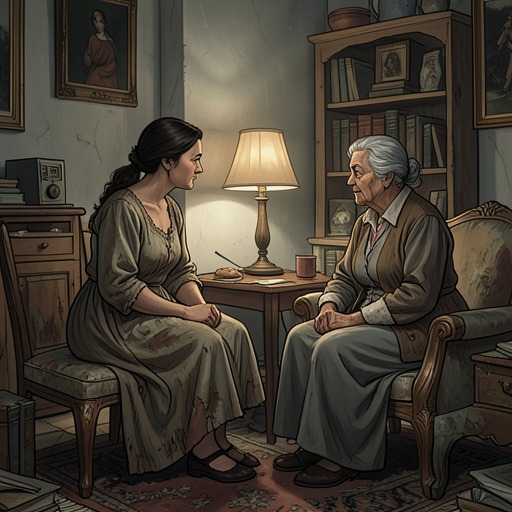
Susana San Juan and Justina Díaz: Lifelong Care and Dependence
Pedro PáramoSusana San Juan and Justina Díaz are bound by a relationship that began in infancy and persists through illness, irritation, fear, and bereavement. Justina is not simply a servant summoned to tend a sick woman: she has held Susana since birth, taught her to walk, and stayed when Susana’s visions and complaints make her work painful. Their attachment is expressed in physical acts of care, in threats to leave that are promptly undone, and in the intimate reassurance they offer one another.
A Bond Formed in Childhood
Justina recalls a relationship that reaches back to Susana’s birth. She held Susana in her arms and taught her to walk, remembering the first steps as unforgettable. Her account dwells on the child’s mouth and eyes, likened to mint candies in changing colors, and on the closeness of bodily care: she let Susana suckle at breasts that had no milk, treating them as toys and inviting her to play. The recollection is tender but unusually physical, conveying a familiarity established before Susana could speak or act independently.
That history gives weight to Justina’s insistence, during Susana’s illness, that she is needed. Her claim is grounded not in a general promise of loyalty but in a lifetime of care. When Susana tells her she cannot go anywhere because nobody will love her as much, the declaration makes explicit the emotional bond that Justina’s memories have already shown through its gestures and duration.
Care Under Strain
The bond does not make their daily life effortless. Susana complains that the cat frightens her during the night, and Justina, exasperated, calls her visions and says she can no longer bear the strain. She threatens to leave the next day and take the cat with her, imagining that work elsewhere would be easier. Her frustration is real, but so is the limit of the threat: Susana answers that Justina will not leave, and Justina immediately promises that she will stay and continue caring for her, even when Susana makes her suffer.
The exchange reveals a repeated tension between exhaustion and attachment. Justina can name the burdens of caring for Susana and briefly picture an exit; Susana, in turn, asserts the depth of their bond. Yet Justina’s response is not merely submission to that assertion. She says that she is there to look after Susana, and her earlier history of care gives that choice a concrete past. The relationship is sustained through irritation rather than sheltered from it: devotion appears precisely where Justina admits how difficult the work has become.
The Voice in the Dark
On a rainy day, Justina comes from Media Luna carrying an umbrella. After crossing the flooded streets and passing the church, she buys rosemary for ten centavos and takes it to Susana’s room. The curtains keep out the light; in the dimness Justina can make out shadows and assumes Susana is asleep. Then a sigh seems to come from a corner, and a voice calls her by name. Although Justina sees no one, she feels a hand on her shoulder and breath near her ear. The voice orders her to leave, saying that she is no longer needed and that it will stay to watch over Susana.
Justina refuses the instruction on the ground that Susana is sick and needs her. She asks whether the unseen speaker is Bartolomé San Juan, then cries out before receiving an answer. The scream carries to people returning from the fields, who describe it as sounding human but belonging to no human being. The episode places Justina’s practical responsibility in a world where presence cannot be established by sight: she enters to tend the living Susana, but an unseen speaker claims the role of watcher. Justina’s immediate response is to defend her place at Susana’s side.
Bereavement and Mutual Consolation
The next morning, Susana calls for Justina, who appears wrapped in a long-haired bedcover. Justina embraces and kisses her until Susana asks why she is crying. Susana promises to tell Pedro Páramo that Justina has been good to her, while also promising not to mention the fears caused by the cat. The offer is a small act of protection: even in distress, Susana attends to Justina’s feelings and tries to reassure her about how her care will be regarded.
Justina then tells Susana that her father died two nights earlier, that the news has only just arrived, and that he has already been buried. The road was too long for his body to be brought back. Justina concludes that Susana is alone in the world, but Susana smiles and says that her father had come to say goodbye. The scene does not resolve the voice’s identity through an answer from the unseen speaker; instead, Susana interprets the encounter in light of the news. Within that uncertainty, Justina remains the person physically present to comfort her. Their lifelong dependence is therefore shown not as one-sided caretaking alone, but as a relationship in which each tries to shelter the other: Justina through her continued presence, Susana through tenderness and reassurance.